
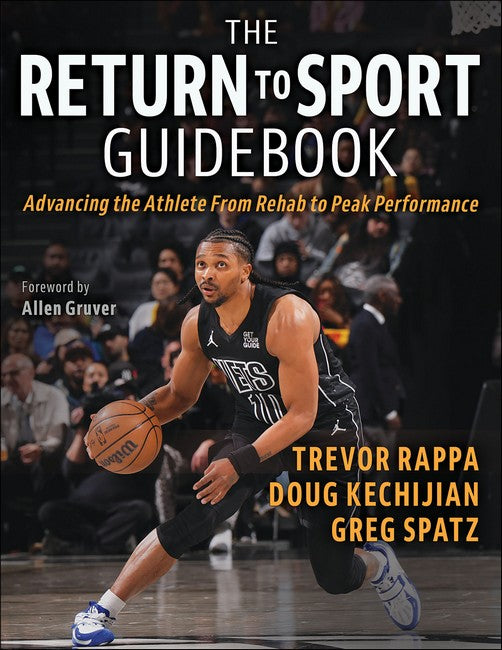
The Return to Sport Guidebook

HUMAN KINETICSISBN: 9781718220201

Price:
Sale price$86.99

By Trevor Rappa, Douglas Kechijian, Gregory Spatz
Imprint:
HUMAN KINETICS
Release Date:

Format:
PAPERBACK
Pages:
320

Description

Prepare athletes to return to sport following an injury.


Bridging the gap between acute physical therapy and sport performance, The Return to Sport Guidebook: Advancing the Athlete From Rehab to Peak Performance guides strength and conditioning coaches through the process of rebuilding athlete strength, power, speed, and agility for both upper- and lower-body injuries. Unlike other resources that provide philosophies and theoretical approaches, this book includes actionable steps such as sample programs and case studies.


In the early chapters youll explore the rationale for approaching return to sport (RTS), including the role of the strength and conditioning professional, the impact of pain on the healing process, and the different phases of rebuilding after an injury. Later, the authors provide foundational movement skills that athletes need to master. Images accompany these descriptions, making it easy to reference when working with an athlete.


After laying the foundation of RTS rationale and basic movement types, coaches will find detailed sample programs and progressions to use with their athletes. The upper- and lower-body programs take you through all the phases of rebuilding, maximizing performance while reducing the risk of reinjury.


With 84 lower-body and 50 upper-body exercises, The Return to Sport Guidebook is an invaluable resource for any coach looking to effectively guide athletes through their rehabilitation journey. Each exercise includes rehab considerations, making it easy to identify when the exercise may be best used and with what injury types. A sample ACL rehab program with descriptions of exercises and drills used throughout the RTS progression is provided.


The return-to-sport process is a long and challenging one. By implementing the exercises and programs in this guidebook, strength and conditioning coaches can feel confident that they are helping their athletes safely rebuild and return to the court or field.


Earn continuing education credits/units! A continuing education exam that uses this book is also available. It may be purchased separately or as part of a package that includes both the book and exam.


Trevor Rappa, Doug Kechijian, and Greg Spatz are the cofounders of Resilient Performance Physical Therapy and Resilient Performance Systems. Resilient systematically navigates the continuum between acute rehabilitation and athletic performance. Resilients clients include athletes from the National Football League (NFL), Major League Baseball (MLB), National Basketball Association (NBA), National Hockey League (NHL), Premier Lacrosse League (PLL), professional mixed martial arts, X Games, Winter and Summer Olympics, and National Collegiate Athletic Association (NCAA); federal law enforcement tactical teams and military special operations forces; and those with a history of persistent pain and extensive surgical backgrounds. Resilient also advises organizations about medical and performance staffing, program development, and injury risk mitigation strategies.


Trevor Rappa, PT, DPT, CSCS, is a performance-based physical therapist who focuses on helping athletes achieve their movement and performance goals. Whether it be acute rehabilitation or sport performance, he recognizes the importance of the biomechanical and neurophysiological aspects of movement patterns. He received his bachelors degree (BS) in biology from Amherst College, where he was a member of the football team. As an undergraduate student, he interned at Mike Boyle Strength and Conditioning facility. He earned his doctor of physical therapy (DPT) degree from Columbia University, holds the Certified Strength & Conditioning Specialist (CSCS) credential, and has advanced training in joint and soft tissue manipulation, movement screening, and dry needling.


Doug Kechijian, PT, DPT, is a performance-based physical therapist who understands the demands placed on athletes at the highest level. Dr. Kechijian did pararescue in the U.S. Air Force, deployed throughout the world to help provide technical rescue capability and emergency medical care to U.S forces and allied forces. He is a nationally certified paramedic with advanced training in emergency, trauma, and wilderness medicine. In 2015, he was selected as one of the U.S. Air Forces Outstanding Airmen of the Year. Dr. Kechijian received his bachelors (AB) degree in biology from Brown University and his masters (MA) degree in exercise physiology and doctor of physical therapy (DPT) degree from Columbia University.


Greg Spatz, PT, DPT, CSCS, is a performance-based physical therapist who recognizes the continuum of rehabilitation to sport performance. With a comprehensive approach to optimizing movement, he helps address the underlying biomechanical and neurophysiological patterns that contribute to injury or performance goals. Formerly a strength and conditioning coach in the Arizona Diamondbacks organization, Dr. Spatz worked with professional baseball players to improve athletic performance while minimizing injury risk. He received his bachelors (BS) degree in health and exercise science from The College of New Jersey, where he was a member of the baseball team. He earned his doctor of physical therapy (DPT) degree from Columbia University and has advanced training in joint and soft tissue manipulation, movement screening, sports medicine, dry needling, and manual therapy.


Part I. Principles Over Methods

Chapter 1. Role of the Performance Coach

Chapter 2. Understanding Pain, Injury, and Healing

Chapter 3. Role of Early-Stage Rehabilitation

Chapter 4. Return to Sport Continuum


Part II. Lower Body

Chapter 5. Lower-Body Biomechanical Principles

Chapter 6. Linear Speed

Chapter 7. Multidirectional Speed

Chapter 8. Strength Classifications and Lower-Body Training

Chapter 9. Multiplanar Plyometrics and Running Vertical Jumps

Chapter 10. Sample Programs and Progressions

Chapter 11. Lower-Body Exercises


Part III. Upper Body

Chapter 12. Upper-Body Biomechanical Principles and Foundations

Chapter 13. Strength, Power, and Plyometrics

Chapter 14. Return to Throwing Progression

Chapter 15. Sample Strength and Plyometric Progressions

Chapter 16. Upper-Body Exercises


You may also like

Recently viewed