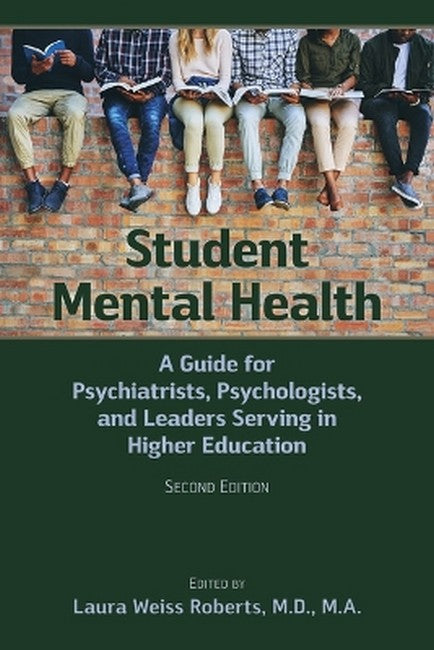
Student Mental Health 2/e


Price:
Sale price$160.00

Edited by Laura Weiss Roberts
Imprint:
AMERICAN PSYCHIATRIC ASSOCIATION PUBLISHING
Release Date:

Format:
PAPERBACK
Pages:
0

Description

Although the image of the "traditional" college student-ages 18-24, entering college immediately after high school, and living on campus full time-remains widespread, studies reveal that only 25% of todays students fit this mold. Modern students are more likely to delay enrollment after high school, manage their own finances, work full-time while enrolled, raise children as single parents, or embody other nontraditional backgrounds. Student Mental Health recognizes that this diverse student body demands a fresh, thoughtful approach to mental health.


More than two dozen expert contributors share their clinical experience in this wide-ranging and comprehensive volume, offering insights into topics such as


* The impact of social media on student well-being

* Strategies for addressing mood disorders, anxiety, and suicidality

* Resources for survivors of campus sexual assault

* The effects of climate anxiety, substance use, and eating disorders

* Technology-driven mental health interventions

* Support for students of color, sexual and gender minorities, students who are neurodiverse, and students who are unhoused

* Considerations for students who are athletes, in the military, or in graduate study


Each chapter features key concepts, discussion questions, and suggested readings designed to spark engagement and further exploration. Real-world case examples throughout the guide also illustrate how core principles are applied in practice.


With an unrivaled breadth and depth of information, Student Mental Health offers an essential framework for institutions, clinicians of all disciplines, and policymakers seeking to address the mental health needs of todays evolving student population.

Laura Weiss Roberts, M.D., M.A., is Chairman and the Katharine Dexter McCormick and Stanley McCormick Memorial Professor in the Department of Psychiatry and Behavioral Sciences at the Stanford University School of Medicine; Editor-in-Chief, Books, at American Psychiatric Association Publishing; Editor-in-Chief of the journal Academic Medicine; and Editor-in-Chief emerita of the journal Academic Psychiatry.


Foreword Chapter 1. Mental health and the university student Chapter 2. Strategies for excellence in student health programs Chapter 3. Clinician self-care in student mental health services Chapter 4. Student self-care, wellness, and resilience Chapter 5. Adaptation and stress Chapter 6. A developmental perspective on risk-taking among university students Chapter 7. Friendships and romantic relationships during the university years Chapter 8. Social media use and university students Chapter 9. University mental health and wellbeing in undergraduate residencies Chapter 10. Distress and academic jeopardy Chapter 11. Existential concerns: climate anxiety and its effects on students on campus Chapter 12. Family relationships during the university years Chapter 13. The psychiatric evaluation of the university student Chapter 14. Mood and anxiety disorders Chapter 15. Addressing suicidality Chapter 16. Intervening early in first-episode psychosis in a university setting Chapter 17. Alcohol and substance use and co-occurring behaviors Chapter 18. Technology addictions Chapter 19. Eating disorders and body image concerns among university students Chapter 20. Attention deficit/hyperactivity disorder and specific learning disorders Chapter 21. Stress and trauma Chapter 22. Response to survivors of campus sexual assault Chapter 23. Students who are medically vulnerable Chapter 24. Sleep disorders Chapter 25. Bringing clinical and ethical considerations together in the care of university students Chapter 26. Brief and medium-term therapies at student health centers Chapter 27. Technology-based mental health care Chapter 28. Students who are first in their families to attend university Chapter 29. Creating a culture of belonging, respect, and support on campus Chapter 30. Students who identify as people of color Chapter 31. Students who identify as a sexual or gender minority Chapter 32. Students who are neurodiverse Chapter 33. Students who are athletes Chapter 34. Students in the military and students who are veterans Chapter 35. Students who are unhoused Chapter 36. Students who are in professional, graduate, and postdoctoral studies Chapter 37. Students who are in medical school and in residency or fellowship training


You may also like

Recently viewed